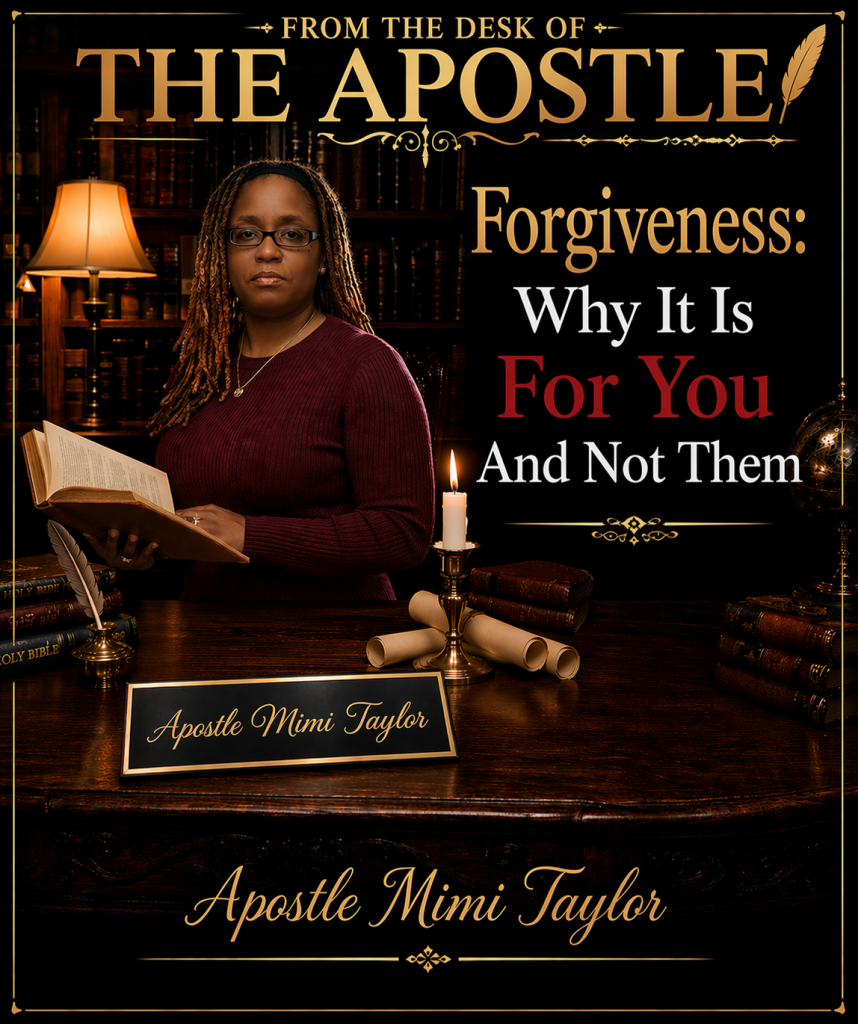
Forgiveness: Why It Is For You And Not Them
By Apostle Mimi
Forgiveness is not merely a moral instruction; it is a spiritual necessity rooted in the nature and character of God. Many within the Body of Christ have approached forgiveness from an emotional standpoint, measuring it by the depth of the wound or the sincerity of the offender. Yet the Kingdom does not operate on emotional reasoning. It operates on truth, obedience, and alignment with divine order.
When we examine the life and ministry of Jesus Christ, we see that forgiveness was never conditional. Even while being crucified, He declared, “Father, forgive them; for they know not what they do.” This was not spoken because those responsible had repented or acknowledged their wrongdoing. It was spoken because forgiveness flows from the nature of God, not the actions of man. Therefore, when the believer refuses to forgive, they are not merely holding onto pain—they are stepping out of alignment with the very nature they have been called to walk in.
Forgiveness is for you because unforgiveness establishes an illegal spiritual occupancy within your soul. It gives room to what God has already judged. When offense is harbored, it does not remain isolated; it begins to produce fruit—resentment, bitterness, hardness of heart, and spiritual dullness. These are not simply emotional responses; they are indicators of a deeper spiritual obstruction. The heart was never designed to carry offense. It was designed to be a vessel of the Spirit of God. When unforgiveness is present, it competes for that space.
Scripture reveals a sobering truth in Matthew 18:34–35, where the servant who refused to forgive was delivered over to tormentors. This passage is not symbolic language meant to instill fear; it is a revelation of a spiritual principle. Unforgiveness opens the door to torment. This torment may manifest as mental unrest, emotional instability, recurring thoughts of the offense, or an inability to move forward. Many seek deliverance from these conditions without addressing the root, yet the root remains unforgiveness.
Forgiveness, then, is an act of spiritual warfare. It is not passive; it is confrontational against the very thing that seeks to bind you. When you choose to forgive, you are actively shutting the door to torment, closing access to bitterness, and reclaiming territory within your soul. You are declaring that what was done to you will not define you, control you, or keep you bound.
It is also important to understand that unforgiveness distorts spiritual perception. When the heart is wounded and unresolved, it begins to interpret everything through the lens of that wound. Relationships are affected, trust is diminished, and even the voice of God can become difficult to discern. This is because unforgiveness introduces filters that were never meant to exist. Forgiveness removes those filters and restores clarity.
Many struggle because they believe forgiveness requires emotional resolution. This is not true. Forgiveness is not a feeling; it is a decision empowered by the Spirit of God. Feelings may follow, but they are not the foundation. In fact, waiting for the feeling to forgive will often result in prolonged bondage. The command to forgive is given because the ability to do so has already been made available through the Holy Spirit.
There is also a critical distinction that must be established: forgiveness does not mean access is restored. One can release an individual from the debt of offense while still exercising godly wisdom in boundaries. Forgiveness deals with the condition of your heart; boundaries deal with the stewardship of your life. The two must not be confused. Failure to establish this distinction has caused many to return to harmful environments under the false belief that forgiveness requires full restoration of relationship. This is not biblical alignment—it is a misunderstanding.
Forgiveness also dismantles pride. At its core, unforgiveness often contains an element of self-exaltation—the belief that one has the right to hold judgment indefinitely. Yet Scripture reminds us that all have sinned and fallen short of the glory of God. When we forgive, we acknowledge our own need for mercy and extend what we ourselves have received. It humbles the heart and repositions the believer under the authority of God rather than above it.
Furthermore, forgiveness is directly tied to spiritual authority. A believer who walks in unforgiveness will find limitations in their ability to operate effectively in prayer, discernment, and spiritual influence. This is because authority flows through alignment, and unforgiveness disrupts that alignment. When forgiveness is embraced, authority is restored. The believer begins to function from a place of freedom rather than restriction.
Another dimension of forgiveness is its role in healing. Many seek healing while holding onto the very thing that prevents it. The wound cannot properly close while the offense is continually reopened through remembrance and resentment. Forgiveness does not erase the memory, but it removes the sting attached to it. Over time, what once produced pain becomes a testimony of God’s sustaining power.
It must also be understood that forgiveness is not always instantaneous in its manifestation. While the decision can be made in a moment, the outworking may require continual surrender. There may be layers to the wound, and as those layers are revealed, forgiveness must be applied again. This is not regression—it is refinement. It is the Holy Spirit bringing deeper areas into the light so that complete freedom can be established.
Forgiveness ultimately repositions the believer into divine trust. It declares that God is just, that He sees all, and that nothing escapes His authority. It releases the burden of needing to understand why something happened or how it will be made right. Instead, it places that responsibility into the hands of the One who judges righteously.
In its fullness, forgiveness is not about the other person at all. It is about your obedience, your freedom, your healing, and your alignment with God. It is about refusing to allow what was done to you to become a permanent residence within you.
Forgiveness is for you because God desires you free. Free in your mind, free in your heart, free in your spirit. Free to love without hindrance, to serve without contamination, and to walk in truth without distortion.
When you forgive, you are not releasing them from accountability—you are releasing yourself from captivity.