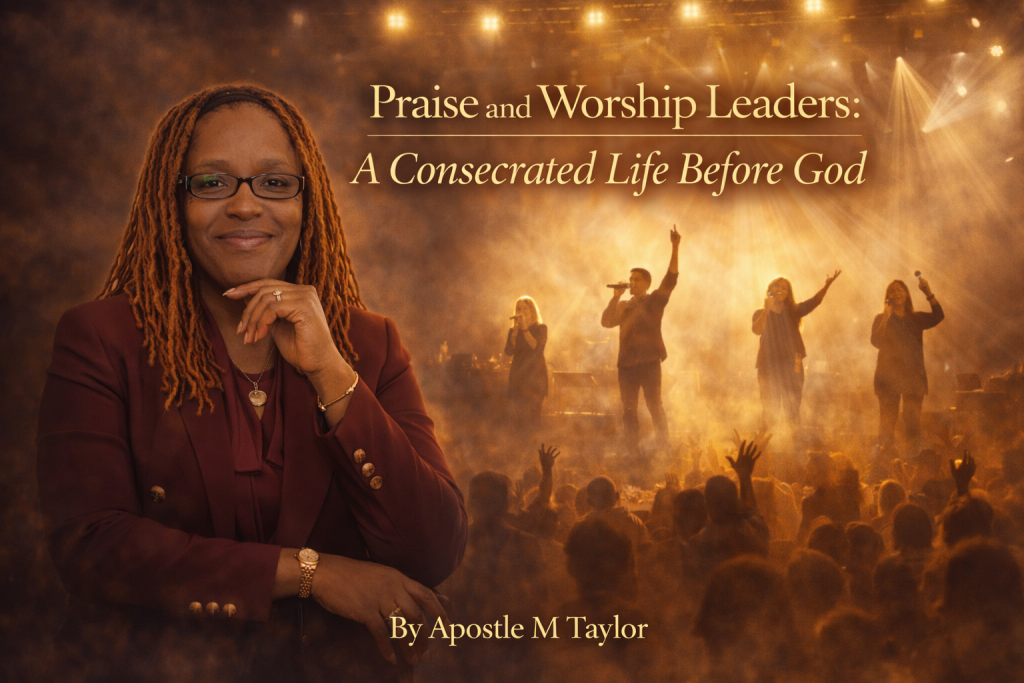
Praise and Worship Leaders: A Consecrated Life Before God
By Apostle M. Taylor
Praise and worship in the house of God is not merely a musical assignment; it is a sacred responsibility. Those who stand before God’s people to lead them into worship are not simply singers, musicians, or performers. They are spiritual facilitators—individuals entrusted with the responsibility of helping usher the congregation into the presence of God. Because of this calling, praise and worship leaders must live lives that are consecrated before the Lord.
Consecration means to be set apart. It is a life that is intentionally devoted to God, surrendered to His will, and committed to living in a way that honors Him both publicly and privately. A praise and worship leader cannot effectively lead people into God’s presence if their personal life is disconnected from Him. What happens on the platform is always influenced by what happens in private. A life that has not been surrendered to God cannot authentically lead others into surrender.
Throughout Scripture, we see that God’s presence responds to purity, humility, and reverence. In the Old Testament, those who ministered before the Lord had to prepare themselves before entering into service. They understood that they were not stepping into an ordinary moment, but into a holy one. While the New Covenant gives believers access to God through Jesus Christ, the principle of reverence and preparation still remains. Leading worship is ministry, not performance.
Praise and worship leaders set the spiritual atmosphere of a gathering. Atmosphere in the spirit is real. When a worship leader approaches the platform with a heart that has been in prayer, in the Word, and in communion with the Holy Spirit, that posture creates an openness for the Spirit of God to move among the people. The congregation often responds to what flows from the leader. If the leader is spiritually sensitive, the room becomes sensitive.
If the leader is distracted or disconnected, the atmosphere can become spiritually dull.
Worship is spiritual leadership. Many people in the congregation arrive carrying burdens, distractions, struggles, and spiritual battles from the week. A consecrated worship leader helps guide the hearts of people from distraction into focus, from heaviness into surrender, and from routine into genuine encounter with God. This is why the spiritual condition of the worship leader matters so greatly. Their sensitivity to the Holy Spirit can help shift the entire atmosphere of a gathering.
This does not mean that worship leaders must be perfect people, but they must be sincere and submitted to the process of sanctification. Consecration is not about outward appearance; it is about the condition of the heart. A worship leader should regularly examine their life, repent when necessary, and remain sensitive to the leading of the Holy Spirit. When the leader’s heart is aligned with God, the worship that flows from them becomes authentic and spiritually impactful.
Another important aspect of consecration is understanding that worship leadership carries influence. Those who lead worship are often visible within the church community, and people naturally observe their example. When a worship leader walks in integrity, humility, and devotion to God, they model what it means to pursue a life that honors Him. Their life becomes a testimony that worship is not limited to songs sung in church but is a lifestyle lived before God.
A worship leader must also guard against allowing gifting to replace relationship. Many people are gifted musically, but gifting alone does not produce the presence of God. Skill may impress people, but only a surrendered heart invites the Spirit of God to move freely. When leaders begin to rely more on talent than on intimacy with God, worship can slowly shift from ministry into performance.
True worship is never about drawing attention to the worship leader. It is about directing hearts toward God. A consecrated leader understands that the goal of worship is not applause, recognition, or emotional hype, but genuine encounter with the Lord. Their desire becomes to decrease so that Christ may be exalted. They recognize that they are simply vessels through which worship flows.
Consecrated worship leaders also remain sensitive to the direction of the Holy Spirit during worship. There are moments when the Spirit of God may lead the atmosphere into deeper reverence, extended worship, spontaneous prayer, or prophetic song. Leaders who walk closely with God are able to discern these moments and allow the Holy Spirit to guide the service rather than forcing their own agenda or schedule.
Another reality that must be acknowledged is that praise and worship leaders often face spiritual opposition. Because worship invites the presence of God and disrupts the works of darkness, the enemy often targets those who lead in this area. This is why worship leaders must remain spiritually disciplined—praying regularly, staying grounded in the Word of God, and guarding their personal walk with the Lord.
A consecrated life becomes both protection and preparation for the spiritual responsibility they carry.
When praise and worship leaders live consecrated lives, something powerful happens. The worship becomes more than music—it becomes ministry. It creates space for the Holy Spirit to convict, heal, restore, and transform lives. The songs become vessels through which God’s presence touches His people. People who walk into the room burdened can leave strengthened. Hearts that were closed can become open. Lives can be changed in the presence of God.
The church does not simply need talented singers or skilled musicians; it needs worship leaders whose hearts belong fully to God. The greatest worship leaders are not necessarily those with the most impressive voices, but those whose lives reflect genuine devotion to the Lord they sing about.
When consecration and worship meet, the atmosphere shifts. The presence of the Lord becomes tangible, and people are drawn into deeper fellowship with Him. Worship becomes a doorway through which people encounter God’s peace, His conviction, His healing, and His love.
For this reason, every praise and worship leader should continually ask themselves a simple but powerful question: Is my life aligned with the God I am leading people to worship?
This question should not be asked with condemnation, but with humility and sincerity. Worship leaders must remember that the platform is not the place where consecration begins—it is the place where consecration is revealed.
Praise and worship leadership is more than a role—it is a calling. And with that calling comes the responsibility to live a life that is consecrated, surrendered, and devoted to the One we lead others to adore.
When the life behind the microphone is surrendered to God, the worship that flows from it becomes a powerful invitation for the Holy Spirit to move freely among His people.