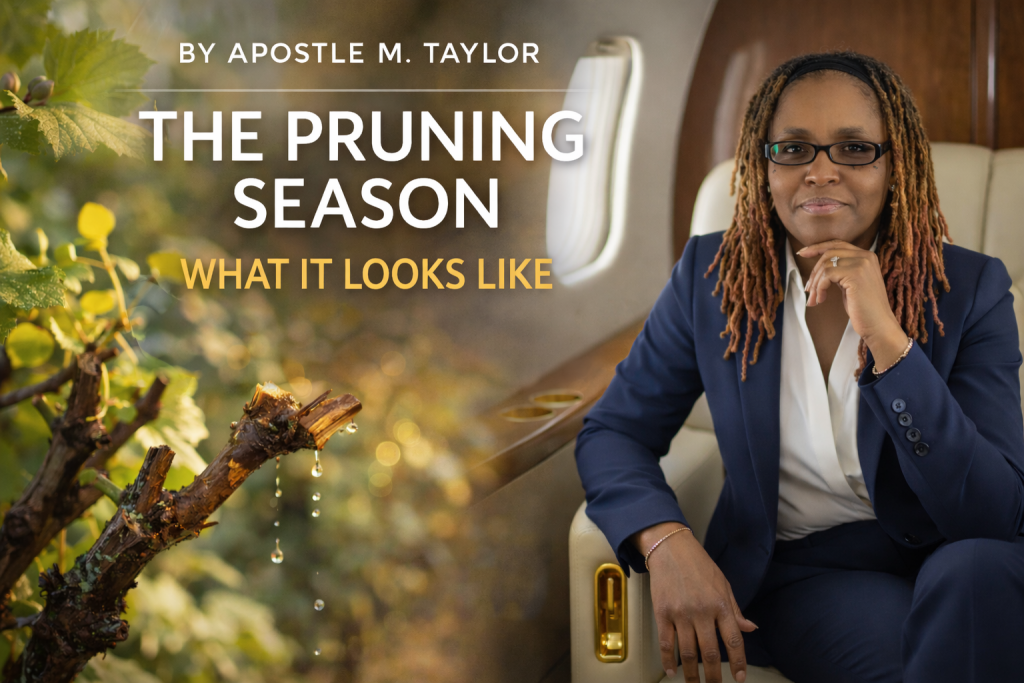
The Pruning Season: What It Looks Like
By Apostle M. Taylor
There are seasons in our walk with God that do not look like growth, do not feel like increase, and do not resemble the promises He spoke over our lives. Instead of expansion, we experience reduction. Instead of elevation, we experience isolation. Instead of abundance, we experience removal. This is what Scripture describes as the pruning season.
Jesus declares in John 15:2, “Every branch that beareth fruit, he purgeth it, that it may bring forth more fruit.” It is important to notice that pruning is not reserved for the barren branch, but for the fruitful one. God does not prune what is dead; He prunes what is productive. The very evidence that you are bearing fruit may be the reason you feel the cutting.
Pruning is rarely comfortable. It often looks like relationships shifting without explanation, platforms decreasing, opportunities drying up, or doors closing that you believed were ordained. It can look like being misunderstood, overlooked, or repositioned when you thought you were about to be promoted. In the natural, pruning seems like loss. In the Spirit, it is divine refinement.
The pruning season exposes what is attached to us that cannot go where God is taking us. It reveals hidden pride, misplaced identity, unhealthy dependencies, and subtle compromises that would sabotage future increase. What we call “blessing” God may call “excess.” What we call “connection” God may call “hindrance.” And what we call “security” God may call “weight.”
During pruning, God is not rejecting you — He is reshaping you. He is cutting away self-reliance so that you depend more deeply on Him. He is removing applause so that your obedience is no longer audience-driven. He is allowing silence so that your intimacy grows beyond performance. The pruning season strips away what feeds the flesh so that the spirit can mature.
It is also a season of hidden work. Much of what God does in pruning happens beneath the surface. You may not see immediate fruit. You may not feel immediate reward. But roots are deepening. Character is stabilizing. Motives are purifying. What you are becoming internally will determine what you can sustain externally.
Many believers resist pruning because they misinterpret it as punishment. Yet Scripture shows us that pruning is an act of care. A loving gardener cuts with intention. He removes what would compete with growth. He trims what would drain life from the branch. The cutting is precise, not careless. The pain is purposeful, not random.
Pruning also tests endurance. It confronts whether we love God for His presence or for His provision. It reveals whether we follow Him for assignment or for affirmation. When the spotlight dims and the crowd quiets, the heart is exposed. And in that exposure, God refines loyalty.
If you are in a pruning season, you may feel smaller than you once were. Your circle may feel reduced. Your responsibilities may look different. Your visibility may be limited. But reduction in the natural often precedes multiplication in the Spirit. God prunes in one season so that you can produce in the next.
The pruning season teaches surrender. It teaches stillness. It teaches trust when you do not understand what is being removed. And perhaps most importantly, it teaches that fruitfulness is not sustained by activity but by abiding. Jesus continues in John 15:4, “Abide in me, and I in you.” Pruning pushes us back into abiding.
What pruning looks like is not glamorous. It is quiet obedience when no one is watching. It is humility when you feel capable of more. It is restraint when you want to respond. It is faith when nothing around you appears to be moving.
But what pruning produces is greater capacity. Greater clarity. Greater purity. Greater strength.
The pruning season is not the end of your fruitfulness. It is the preparation for fruit that will last.
Allow Him to cut. Allow Him to refine. Allow Him to remove what cannot carry the weight of your next season.
Because what survives pruning
is what God intends to use.